
Vajrasattva Retreat: 3 Months
Retreat Details
January 11 - April 11, 2027
January 7, 9:00 AM - 5:00 PM
April 11, after lunch
US $2,120 — meals, room & books included
Retreat Overview
The most powerful remedy to negative karma
The Buddha taught that in order to achieve success in our Dharma practice — our own inner transformation — it is essential to purify the negative karmas we have collected with our body, speech, and mind in this and past lives.
This can be achieved through the skillful practice of four opponent powers: reliance (the taking of refuge in the Buddha, Dharma, and Sangha and the generation of bodhicitta), regret (a healthy acknowledgement of our mistakes), remedy (a positive countering action), and resolve (the promise to refrain from making the same mistake again in the future).
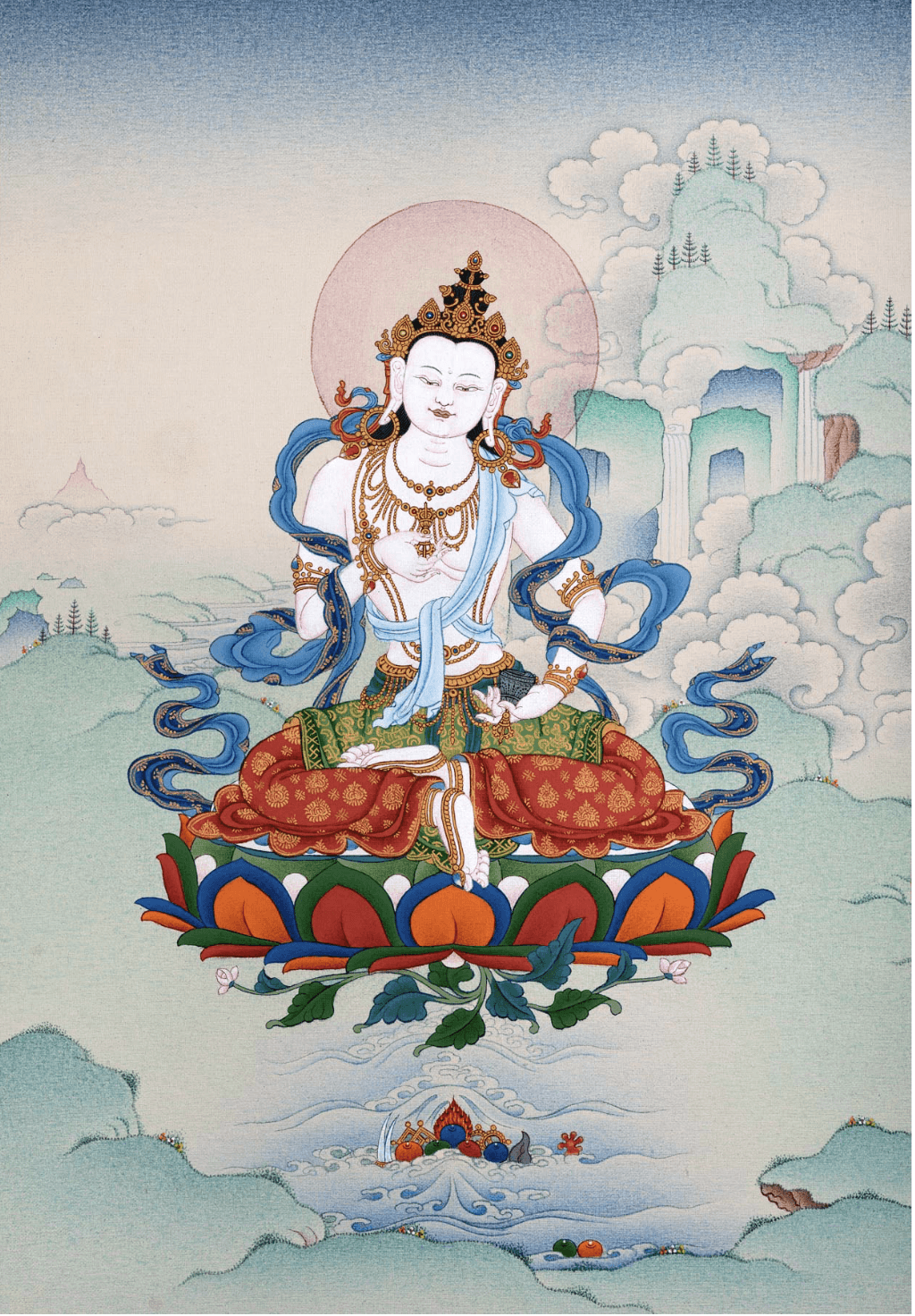
One of the most powerful remedies to our negative karma is the practice of Vajrasattva. This is a particular buddha who we visualize above our head while reciting his mantra and imagining rays of light flowing down into us, purifying our negative karmas.
Many practitioners do this practice at the end of every day to purify the negative karma they created during that day. However, the recitation of 100,000 long mantras of Vajrasattva is also one of the ten preliminary practices done in Lama Tsongkhapa's tradition of Tibetan Buddhism. Please note that in actuality, participants are required to recite 111,000 mantras to complete the preliminary practice, with the additional mantras being recited to make amends for mantras that were not pronounced correctly, were recited with a distracted mind, and so forth.
This number of mantras can be completed by most people in a three-month retreat in which participants do four sessions of mantra recitation a day, each of about two hours in length.
RETREAT DETAILS:
Dates: January 11 - April 11, 2027
Check-in : January 7, 9:00 AM - 5:00 PM
Departure : April 11, after lunch
Fee (from January 7-April 11) : US $2,120
This includes two meals a day (breakfast and lunch), a private room, the practice books, an image of Vajrasattva, and a concluding Dorje Khadro fire puja.
Please note that you will be charged Kopan's usual room and board fees if you arrive earlier than January 7th or leave later than April 11th.
CONDITIONS FOR ATTENDING THE RETREAT
To do this retreat, it is necessary to be a Buddhist, i.e., one must have taken formal refuge in the Buddha, Dharma, and Sangha.
It is essential to have attended a complete lamrim meditation course, such as the one-month November course at Kopan Monastery, or have completed the full Discovering Buddhism Course as offered by FPMT.
Although not obligatory, it would be good to have received a Vajrasattva initiation (also known as a jenang in Tibetan or subsequent permission in English). At Kopan, this initiation is currently given by the abbot of Kopan Monastery at the end of every one-month November course, and in the past it was conferred by Lama Zopa Rinpoche.
You must commit yourself to stay for the entire three-month retreat, irrespective of whether you have a commitment or not to complete 100,000 Vajrasattva mantras or a three-month Vajrasattva retreat.
You must commit yourself to abide by the retreat discipline as set out by the retreat leader. This retreat is not a holiday! It is hard and intensive mental and emotional work, and you need a firm motivation for doing the retreat and a strong determination that will enable you to cope with the difficulties that will inevitably arise.
If you have a personal Dharma teacher, it would be good to ask him/her whether he/she thinks that you have sufficient background in the Dharma and are psychologically strong enough to do the retreat at this time.
IMPORTANT: It is not possible to do this retreat at Kopan if you have a history of mental problems, as there is a real risk they may worsen and Kopan does not have trained support personnel.
RETREAT PLACE AND ROOMS
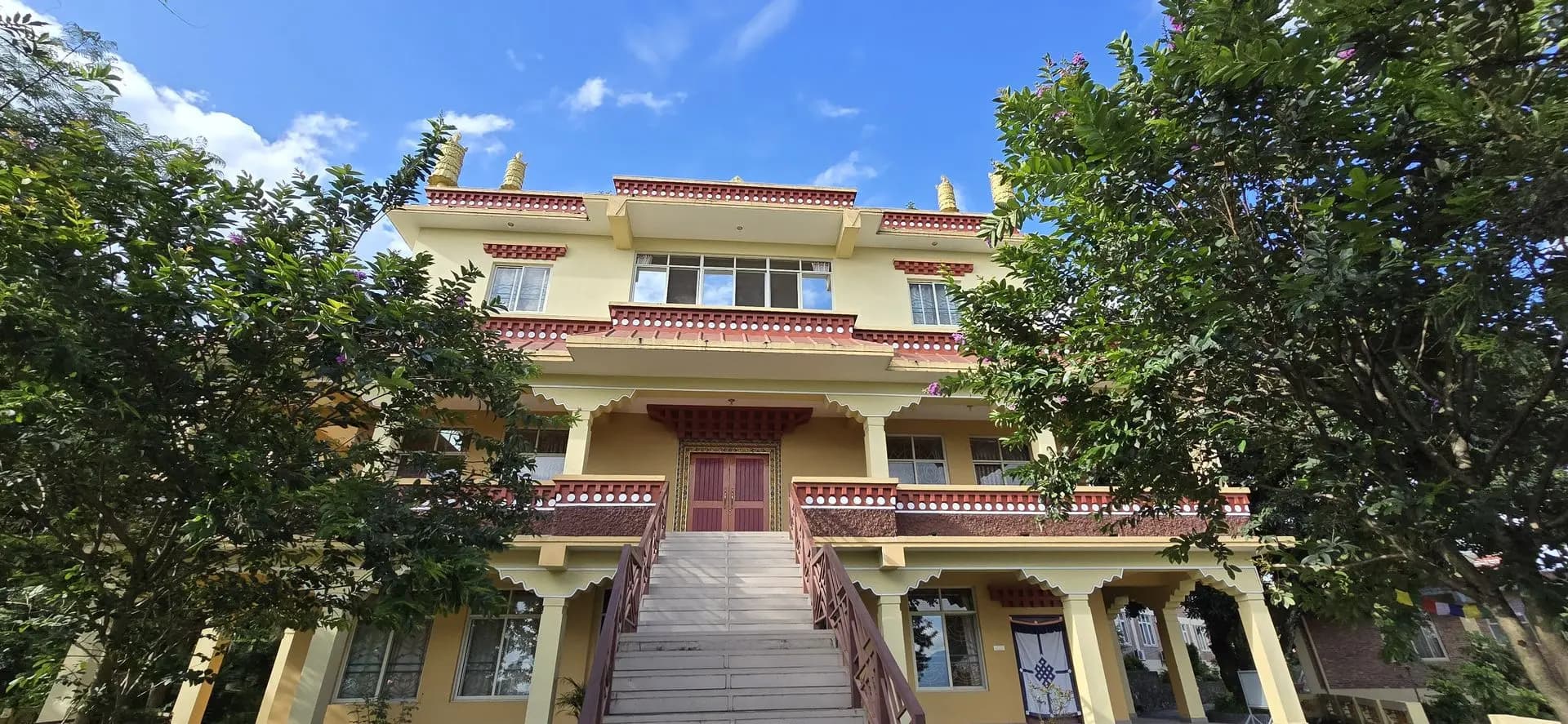
The retreat takes place in the Vajrasattva Gompa, a spacious room on the floor below the Chenrezig Gompa. It is equipped with a beautiful altar containing statues of Vajrasattva and the Seven Medicine Buddhas along with photos of our principal lamas. Large and small cushions are provided but if you have your own personal ones, and will be more comfortable with them, please bring them along. Yoga mats are available for prostrations.
You will be allocated rooms in a location reserved for Vajrasattva retreaters, possibly in the same building as the Chenrezig Gompa.
RETREAT STRUCTURE
Retreat Leader
A retreat leader will guide the four daily sessions for the first ten days of the retreat. Thereafter, the retreaters take turns leading the sessions, while the retreat leader remains available to answer questions, to help with any difficulties that may arise, and to provide personal support. The retreat leader will also guide additional practices such as bimonthly Vajrasattva Tsog Offering and occasional and concluding Dorje Khadro fire pujas.
Schedule
The retreat will start on the afternoon of January 11, 2026. Prior to that, there will be three days of preparation with ample time to do personal shopping in town.
During the retreat, there will be four sessions of Vajrasattva meditation and recitation a day. For the first ten days of the retreat, the four sessions will gradually be extended from an initial 90 to 105 minutes. For the rest of the retreat, each session will last for two hours. The first session usually starts at 5:30 AM and the last session usually ends about 8:00 PM. There will be a group meeting with the retreat leader once a week throughout the first and third months of the retreat where you can get your questions answered and get help to resolve any problems that may arise during the retreat.
The Eight Mahayana Precepts will be taken for three one-month periods for the duration of the retreat. These eight precepts are taken with a bodhicitta motivation to support your purification practice. Please note that one of these precepts involves refraining from eating after noon, due to which participants will only be served breakfast and lunch for the duration of the retreat. The precepts also involve refraining from eating certain foods, such as meat, eggs, onions, and garlic, and refraining from smoking. If you think that the eating restrictions will be a problem for you (e.g., due to a medical condition), please mention this on the application form as any exceptions will need to be discussed with the retreat leader prior to acceptance into the retreat.
For more information on the benefits of the Eight Mahayana Precepts, please read The Unmistaken Method by Lama Zopa Rinpoche, published by Lama Yeshe Wisdom Archive (LYWA) and available on lamayeshe.com.
KEEPING SILENCE
For the entire 1st and 3rd months, participants are asked to keep silence from the end of the last session of the day until the beginning of lunch the next day. Communication is restricted to other members of the retreat, the retreat leaders, and the Kopan office staff. Participants keep strict silence for the whole of the second month of the retreat, refraining even from talking to each other. To support the practice of keeping silence, you must leave your mobile phone with reception from the first day of the retreat until the last.
EXPECT INITIAL DIFFICULTIES WHEN DOING THE RETREAT
It is necessary to familiarize yourself with the long hundred-syllable Vajrasattva mantra prior to the retreat in order to be able to comfortably complete the retreat in three months, free of stress. Doing so will make it possible to easily and quickly recite the mantra right from the very beginning of the retreat. Otherwise, the experience of most people is that during the first weeks, the mantra count is very slow, making it difficult to imagine that you will be able to complete the required number of mantras in the time allotted.
Please note that the mantra that is to be recited is the usual long Vajrasattva mantra (i.e., not that of Heruka Vajrasattva). This is the Vajrasattva mantra that corresponds with the jenang that was most often conferred by Lama Zopa Rinpoche and the one that is currently conferred by Khen Rinpoche Chonyi at Kopan Monastery, Yangten Rinpoche at Tushita Meditation Centre, and many other Gelug lamas:
OṂ VAJRASATVA SAMAYA / MANUPĀLAYA / VAJRASATVA TVENOPATIṢṬHA / DṚḌHO ME BHAVA / SUTOṢYO ME BHAVA / SUPOṢYO ME BHAVA / ANURAKTO ME BHAVA / SARVA SIDDHIM ME PRAYACCHA / SARVA KARMASU CA ME / CITTAṂ ŚRĪYAṂ KURU HŪṂ / HA HA HA HA HOḤ / BHAGAVĀN SARVA TATHĀGATA / VAJRA MĀ ME MUÑCA / VAJRĪ BHAVA / MAHĀ SAMAYASATVA ĀḤ HŪṂ PHAṬ
Even having familiarized yourself with the mantra, you will still find that as the retreat progresses your mantra recitation will become even quicker. For this reason, it is rather unusual for someone to not be able to complete 100,000 mantras in the three months.
So please be prepared to not be able to recite the necessary number of mantras in the first weeks of retreat, and do not become concerned or anxious about this. Lama Zopa Rinpoche often stressed that the other parts of the session—the motivation, the lamrim meditation, the prostrations to the Thirty-Five Buddhas, the visualizations, and the accompanying prayers—are just as important and should not be forgotten in the rush to finish the mantras.
REMEMBER THAT YOU ARE DOING A GROUP RETREAT
We ask people doing this retreat to remember that you have chosen to participate in a group retreat. It is expected that there will be some inevitable personality clashes when living and practicing so closely with others. A big part of this retreat is learning to be relaxed and to give yourself and others the space and support to do the practice at a comfortable level for each person. There are many advantages to doing this retreat as a group, including the support received through sharing the experience with others.
However, if you have considerable experience doing individual tantric retreats and feel confident that you have the necessary self-discipline to do a three-month solitary Vajrasattva retreat, you may want to consider doing that instead of the group retreat, either during the same or a different time period at Kopan or at another suitable location.
Please note that the retreat leader, as well as an experienced former Vajrasattva retreat leader and the Kopan SPC, are available during the retreat if you need to discuss anything. Although much of the retreat will be in silence, please be aware that this does not mean you cannot seek help if and when you need it.
RETREAT DISCIPLINE
Silence as outlined above.
No communication with non-retreaters as outlined above.
Retreaters must attend all sessions of the retreat unless sick. The retreat leader must be informed if you are unable to attend.
Come to all sessions a few minutes before the sessions begin in order to prepare the practice books, etc.
Be kind and sensitive in your behavior toward fellow retreaters.
Do not do practices other than the Vajrasattva practice during session times.
It is not permitted to leave Kopan during the retreat (please settle all travel arrangements, calls, etc. before the retreat begins), except for medical emergencies. You can walk around the grounds and stupas to get some daily exercise.
Couples wishing to do this retreat are encouraged to remain as separate from each other as possible. Retreat is an individual process, and only by distancing oneself from one's partner can the maximum benefit be gained.
To help the retreat be a deeper experience with as few distractions as possible, we ask retreaters not to receive or send letters or emails during the retreat. If you know it is absolutely necessary to receive mail, please ask the person sending it to mark it as “Urgent,” and we can make sure you receive it. Otherwise, letters will be kept until the end of the retreat. If you need to make online payments for rent etc. during the retreat, please coordinate this with the Kopan SPC.
No singing, listening to music, or playing music.
Please be very aware of how you dress - this is a monastic environment, and wearing tight clothes, shorts (also men),sleeveless and revealing T-shirts, etc., is not appropriate.
No sunbathing or otherwise exposing your body in public.
Keep silence around rooms at all times so as not to disturb each other between sessions.
If a person's behavior becomes disturbing to the group, the management has the right to ask them to leave.
MEALS
Vegetarian meals will be provided, sometimes containing wheat and milk products. Special diets such as wheat-free or lactose-free cannot be accommodated.
Filtered water is available from the dining hall at all times.
WHAT TO BRING
A Mala with 111 beads
You will need a matching set of vajra (in Tibetan, a dorje) and bell for the retreat. (These can be bought in Boudha at a very reasonable cost)No communication with non-retreaters as outlined above.
A cloth for placing your vajra, bell, and a cover for these items between sessions.
Some pocket money for purchasing items from the shop (Dharma items, chocolate, toilet paper, soap, washing powder, candles, etc.), or for extra photocopying.
Any personal medication you may need
Vitamins and other supplements
Fiber supplements
Protein supplements or protein-rich snacks, as the diet is vegetarian and this may be helpful
A reusable water bottle
A mug
Slip-on shoes (easy to put on and take off)
A hat for sun protection
Weather-appropriate, loose, and comfortable clothing (please check our dress code)Keep silence around rooms at all times so as not to disturb each other between sessions.
Sunscreen
Toiletries
A hot water bottle (advised)
WHAT NOT TO BRING
Mobile phones, computers, novels, or other distractions.A Mala with 111 beads
A hand drum or an inner offering container will not be necessary for this retreat.
A COVID test is not required.
RECOMMENDED READING LIST
It is a good idea to read at least some of the books on the recommended reading list before coming to the Vajrasattva retreat, so you have a better idea of what to expect, and particularly more awareness of why it's so beneficial to do this retreat and how to get the most benefit from it.
Particularly, before coming to the retreat we recommend reading Becoming Vajrasattva: The Tantric Path of Purification by Lama Yeshe. While several copies will be available to retreaters, having your own copy of the book during the retreat is highly recommended. In addition, the book Teachings during Vajrasattva Retreat by Lama Zopa Rinpoche provides much essential advice for getting the most out of a Vajrasattva retreat.
Particularly, before coming to the retreat we recommend reading Becoming Vajrasattva: The Tantric Path of Purification by Lama Yeshe. While several copies will be available to retreaters, having your own copy of the book during the retreat is highly recommended. In addition, the book Teachings during Vajrasattva Retreat by Lama Zopa Rinpoche provides much essential advice for getting the most out of a Vajrasattva retreat.
Retreaters will be provided with the Vajrasattva practice book, a photo of Vajrasattva, and a prayer book with all the prayers needed during the retreat.
Becoming Vajrasattva: The Tantric Path of Purification
Lama Thubten Yeshe — Wisdom Publications
Introduction to Tantra
Lama Thubten Yeshe — Wisdom Publications
Teachings during Vajrasattva Retreat
Lama Zopa Rinpoche — Lama Yeshe Wisdom Archive (free pdf at lamayeshe.org)
Preparing for Tantra
Lama Tsongkhapa — Classics of Middle Asia
The Door to Satisfaction
Lama Thubten Zopa Rinpoche — Wisdom Publications
Liberation in the Palm of Your Hand
Pabongka Rinpoche — Wisdom Publications
Wisdom Energy
Lama Thubten Yeshe & Lama Zopa Rinpoche — Wisdom Publications
Vajrasattva Retreat · Jan-Apr 2027
US $2,120 · Private room & all meals included
Quick Links
FAQ
Privacy Policy
